
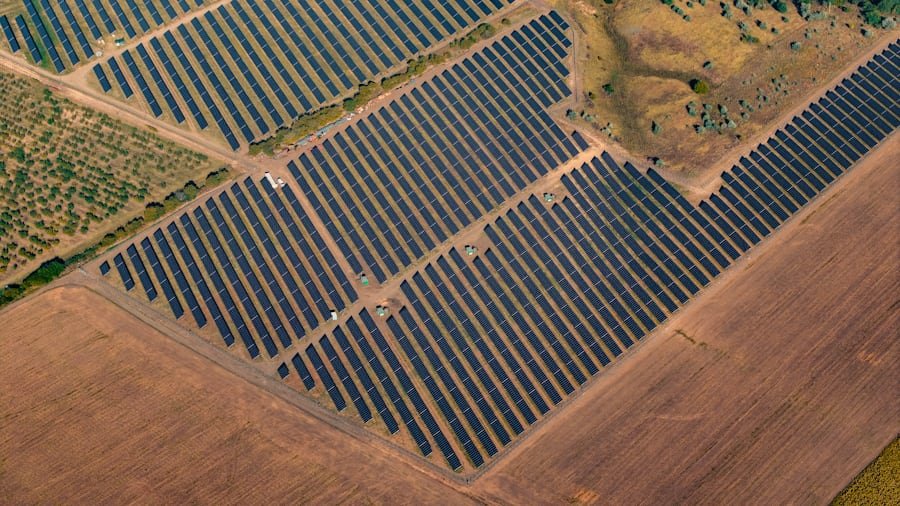
For an industrial business in Oman, electricity is one of the largest controllable costs — and one of the biggest carbon liabilities. Commercial solar in Oman solves both. With renewables climbing from 4.26% of the grid in 2024 to 9.46% in 2025, and national policy pushing toward 30% by 2030, on-site solar has moved from “nice to have” to a genuine competitive advantage. This guide explains payback, the EU carbon-tax angle, and how factories get approved and connected.
Key fact: A commercial solar plant can typically supply about 40% of the power for a 24-hour industrial facility, and up to 60% for daytime-only operations.
Why factories in Oman are switching to solar
Three drivers make industrial solar compelling right now:
- Cost control. Daytime factory load lines up almost perfectly with solar generation, so most of what you produce is used on-site instead of exported — maximising savings.
- Export competitiveness. The EU and US are introducing carbon border taxes (such as CBAM). Cutting your factory’s carbon footprint directly protects export margins.
- National momentum. Projects like the 93 MW Suhar Industrial City solar plant show large-scale industrial solar is already live in Oman, designed to meet around 40% of tenants’ energy needs.
Commercial solar payback in Oman
Payback depends on system size, your tariff, and how much energy you self-consume. The higher your daytime consumption, the faster the return. A typical industrial profile looks like this:
| Factor | Impact on payback |
|---|---|
| High daytime load | Faster payback (more self-consumption) |
| Large flat roof | Lower cost per kWp |
| Export-focused business | Extra value from carbon reduction |
| Battery storage added | Longer payback, but more resilience |
The single biggest lever on payback is self-consumption. A proper load analysis — which Al Mukhtar United provides — is essential before sizing the system. Request a free assessment.
Solar and the EU carbon tax (CBAM)
If your business exports to Europe, this section matters. The EU’s Carbon Border Adjustment Mechanism prices the carbon embedded in imported goods. Factories powered partly by solar report a lower carbon footprint, reducing exposure to these charges. In other words, commercial solar in Oman is now an export-competitiveness tool, not just an energy saving. This is a decisive advantage for manufacturers in free zones like Sohar and Duqm.
How commercial solar gets approved in Oman
Industrial grid-connected systems follow the APSR framework, run through your distribution company (DSO):
- Initial enquiry — submit site, load, and proposed capacity.
- Design approval — the DSO checks the design against APSR technical and safety rules.
- Commissioning — inspection, metering (Main Meter + PV Meter from the approved list), and grid connection.
For a step-by-step breakdown aimed at smaller systems, see our rooftop solar in Oman guide. Al Mukhtar United handles the design, compliance, and installation so your operations team doesn’t have to.
Choosing an electrical contractor for industrial solar
Industrial solar is an electrical engineering project first and a “green” project second. Look for a contractor that:
- Is a licensed electrical contractor familiar with APSR and DSO requirements.
- Can handle both the solar array and the electrical integration (switchgear, protection, metering).
- Provides ongoing operations and maintenance (O&M).
- Understands industrial load profiles, not just residential rooftops.
Al Mukhtar United combines electrical construction and solar energy expertise under one roof — which matters, because the connection point between your PV system and your electrical infrastructure is where projects succeed or fail. We also support ongoing building operations to keep systems performing.
Frequently Asked Questions
Is commercial solar worth it for factories in Oman?
Yes. Factories have high daytime electricity demand that matches solar output closely, so most generated power is used on-site. This delivers strong savings, and for exporters it also reduces carbon border-tax exposure. A load analysis determines the exact return for your facility.
How much of a factory’s power can solar provide in Oman?
A well-designed commercial solar plant can supply roughly 40% of the power needs of a 24-hour operation and up to 60% for daytime-only operations. The exact figure depends on roof area, load profile, and whether battery storage is added.
Does solar help with the EU carbon tax (CBAM)?
Yes. By reducing the carbon intensity of your electricity, on-site solar lowers the embedded carbon in your products, which can reduce charges under the EU’s Carbon Border Adjustment Mechanism. This is increasingly important for Omani exporters to Europe.
What approvals does a commercial solar system need in Oman?
Commercial systems must pass the APSR’s three-stage process — initial enquiry, design approval, and commissioning — administered through your distribution company, including approved metering. A licensed contractor manages this compliance for you.
Can one contractor handle both electrical work and solar?
Ideally, yes. The interface between the solar array and a factory’s electrical system (switchgear, protection, metering) is critical. A contractor like Al Mukhtar United that does both electrical construction and solar avoids the coordination gaps that cause delays.
Cut your factory’s energy costs
Commercial solar in Oman lowers operating costs, strengthens export competitiveness, and supports Vision 2040 — provided the system is correctly sized and professionally integrated with your electrical infrastructure. Contact Al Mukhtar United for a free commercial solar assessment for your facility.
Ready to move from planning to installation? See our step-by-step commercial solar installation guide, covering zero export, sizing, and system components.